AI in India: How Artificial Intelligence Is Transforming Education, Skills & Jobs
Discover how AI is transforming education, skill development, employment, and innovation in India. Explore opportunities, challenges, and the future of Artificial Intelligence.
Published
24 Jul 2026
Reading Time
6 min read
Written By
Admin User
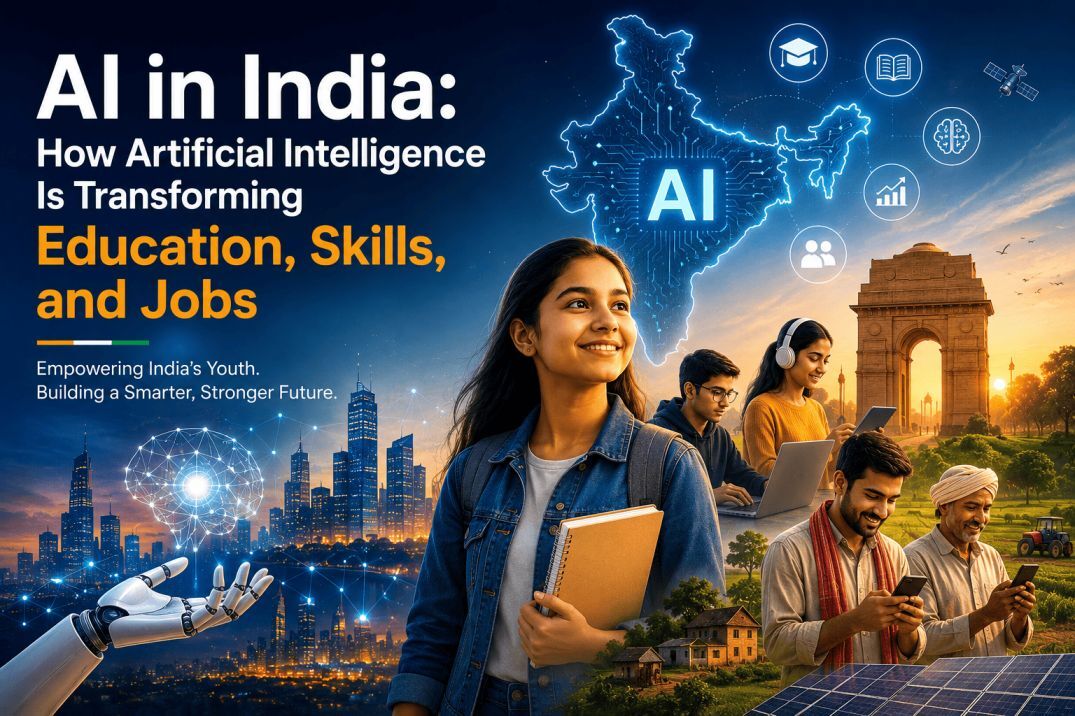
AI as a Catalyst for Skills Development and Societal Transformation in India
How Artificial Intelligence is reshaping education, employment, and innovation for the world's youngest nation.
Introduction
Artificial Intelligence (AI) is no longer a futuristic concept—it is becoming one of the most transformative technologies of our time. While much of the global conversation revolves around AI replacing jobs, India has a unique opportunity to frame the narrative differently.
For a country with the world's largest youth population, AI is not just about automation; it is about empowerment, accessibility, and economic inclusion.
From helping students learn in their native languages to enabling entrepreneurs to build global products without massive capital, AI has the potential to remove barriers that have existed for decades. If adopted responsibly, it can become one of India's greatest catalysts for skills development and societal transformation.
India's AI Moment: Why This Opportunity Is Different
India stands at a unique intersection of demographics and technology.
Every year, millions of young Indians enter the workforce with aspirations for better careers and higher incomes. Traditional education and training systems struggle to scale fast enough to meet this demand.
AI changes that equation.
Instead of relying solely on classrooms, expensive coaching centers, or limited access to experts, intelligent systems can provide personalized learning experiences to anyone with an internet connection.
This shift transforms AI from merely a productivity tool into a nationwide education infrastructure.
Rather than replacing human potential, AI can amplify it.
AI Is Democratizing Opportunity
Historically, building a successful company required significant capital, specialized talent, and years of development.
Today, AI is changing that reality.
Modern AI tools help entrepreneurs:
Write code faster
Design products
Create marketing content
Analyze customer behavior
Build prototypes
Automate repetitive work
Launch businesses with smaller teams
The biggest advantage is that great ideas matter more than large budgets.
A student in a small town now has access to many of the same AI-powered capabilities as a startup in Silicon Valley.
This democratization of innovation may become one of India's greatest economic equalizers.
Skill Development Is Becoming the New Currency
The AI era rewards adaptability rather than static knowledge.
Degrees alone will no longer guarantee long-term career success.
Instead, professionals will increasingly be valued for their ability to:
Learn continuously
Solve complex problems
Think critically
Collaborate with AI systems
Adapt to changing technologies
Learning itself is becoming a lifelong process.
This is especially important for India, where millions of young professionals will need to upskill multiple times throughout their careers.
Transforming Education Through AI
Education is undergoing one of the biggest transformations in history.
Instead of standardized learning for everyone, AI enables personalized education tailored to each student's strengths, weaknesses, and pace.
Future classrooms can include:
Personalized Learning
AI tutors explain difficult concepts based on each learner's understanding rather than following a one-size-fits-all curriculum.
Instant Feedback
Students receive immediate guidance instead of waiting for assignments to be graded.
Adaptive Learning Paths
Lessons automatically adjust according to performance, helping learners progress efficiently.
Affordable Access
Quality education becomes accessible even in remote villages where experienced teachers may not always be available.
This creates a more inclusive education system capable of reaching millions simultaneously.
Why Computational Thinking Matters More Than Ever
Preparing students for an AI-driven future requires more than teaching programming languages.
Children should learn how to think like problem solvers.
Computational thinking includes:
Breaking large problems into smaller ones
Identifying patterns
Designing logical processes
Building systematic solutions
Evaluating outcomes critically
These skills remain valuable even as AI automates coding and repetitive tasks.
The future belongs to people who know how to think, not simply what to memorize.
Language Inclusion: AI Must Speak Every Indian Language
India's diversity is one of its greatest strengths.
However, language has often limited access to quality education and digital services.
Most online learning resources are still heavily English-centric.
AI has the ability to remove this barrier.
Advanced language models can now:
Translate educational content
Understand regional dialects
Provide voice-based learning
Assist rural entrepreneurs
Help farmers access government information
Support artisans in reaching wider markets
By embracing multilingual AI, India can ensure that technology benefits every community—not just English-speaking urban populations.
True digital inclusion begins with linguistic inclusion.
AI and the Future of Work
AI is changing nearly every industry.
Routine tasks are increasingly automated, allowing organizations to operate faster and more efficiently.
However, this transformation also creates challenges.
Entry-level and repetitive roles are particularly vulnerable to automation.
Industries relying heavily on manual data processing or standardized workflows will experience significant changes.
Rather than viewing AI as a job destroyer, it is more accurate to see it as a job transformer.
Future careers will emphasize:
Decision-making
Creativity
Emotional intelligence
Strategic thinking
Communication
Human-AI collaboration
The workers who thrive will be those who continuously update their skills.
Public-Private Partnerships Are Accelerating AI Adoption
Large-scale societal transformation requires collaboration.
Government initiatives combined with private-sector innovation can accelerate AI adoption far more effectively than isolated efforts.
Programs focused on digital skill development demonstrate this approach by offering:
AI-powered career guidance
Interactive learning platforms
Chatbot-based assistance
Digital certifications
Employment resources
Partnerships with global technology companies further strengthen these ecosystems by bringing advanced AI capabilities to millions of users.
Continuous user feedback enables these systems to improve rapidly while remaining accessible to diverse populations.
Beyond Technical Skills: The Human Advantage
Ironically, as AI becomes more capable, human qualities become even more valuable.
Future professionals will need a balance of technical and interpersonal abilities.
Skills that AI cannot easily replicate include:
Storytelling
Leadership
Empathy
Ethical reasoning
Creativity
Cultural understanding
Collaboration
For India, this is particularly significant.
The country's rich diversity of languages, traditions, and experiences creates opportunities to tell authentic stories that resonate globally.
AI can become a powerful creative partner—but human imagination remains the driving force.
Resilience Will Define the Next Generation
One of the most important lessons of the AI era is that careers will no longer follow predictable paths.
People will change industries.
They will learn new technologies.
They will reinvent themselves multiple times.
Failure should no longer be viewed as an endpoint but as part of the learning process.
Successful entrepreneurs, innovators, and professionals all share one common trait:
They keep learning.
Resilience, curiosity, and adaptability will become the defining characteristics of tomorrow's workforce.
Challenges India Must Address
Despite enormous potential, AI adoption is not without obstacles.
India still faces several critical challenges:
Unequal digital infrastructure
Limited AI literacy
Data privacy concerns
Workforce reskilling at scale
Ethical AI governance
Automation-driven job displacement
Regional technology accessibility
Addressing these issues requires coordinated efforts from governments, educational institutions, businesses, and civil society.
Responsible AI development must remain central to India's digital future.
The Road Ahead
India has an opportunity unlike any other nation.
Its youthful population, rapidly expanding digital infrastructure, entrepreneurial ecosystem, and growing AI capabilities create the foundation for transformative growth.
The question is no longer whether AI will reshape society.
The real question is whether India can prepare its people to lead that transformation.
If education evolves, skills remain at the center of development, regional languages are embraced, and lifelong learning becomes the norm, AI can become one of the greatest forces for inclusive growth in the country's history.
Conclusion
Artificial Intelligence is far more than a technological breakthrough—it is an opportunity to redefine how India learns, works, and innovates.
It lowers barriers to entrepreneurship, democratizes access to education, expands opportunities for rural communities, and empowers individuals to compete on a global stage.
Yet technology alone is not enough.
The future belongs to those who continuously learn, embrace change, and combine AI with uniquely human strengths such as creativity, empathy, and critical thinking.
India's greatest advantage is not AI itself.
It is the millions of young minds capable of using AI to build solutions that improve lives, strengthen communities, and shape the future of the nation.
The AI revolution has already begun. The next chapter depends on how prepared we are to learn, adapt, and lead.