Flutter vs React Native 2026: Which is Better for Your App?
A deep dive into Flutter vs React Native in 2026. Compare performance, architecture, and AI-tool compatibility (Cursor/Windsurf) to choose the best framework for your next mobile app.
Published
06 Apr 2026
Reading Time
5 min read
Written By
Admin User
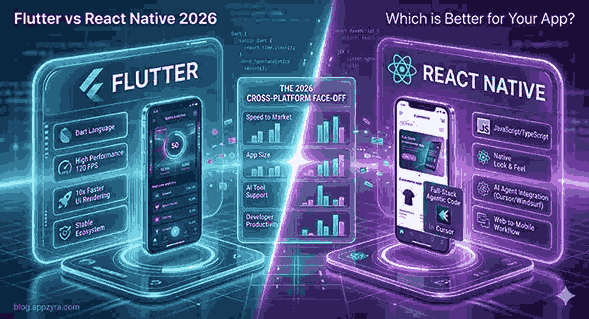
Flutter and React Native are the top cross-platform frameworks in 2026, and choosing between them depends entirely on your project goals. If you want a high-performance app with a custom, pixel-perfect design that looks identical on Android, iOS, and Web, Flutter is the better choice because it draws its own UI using the Impeller engine. It is ideal for stable, 180Hz animations and offers a highly structured, "batteries-included" development experience using the Dart language.
1. The Dominance of Cross-Platform Development
The landscape of mobile and web development has fundamentally changed. Building separate codebases for iOS, Android, and Web is now a luxury few projects can afford. The solution is cross-platform frameworks, and in 2026, Flutter and React Native remain the undefeated champions.
Both tools allow developers to write code once and deploy it across multiple platforms, but their methodologies, languages, and philosophies are vastly different. Here’s a detailed breakdown to help you make the right choice.
2. Performance and Rendering Architecture
The biggest technical differentiator between the two is how they handle the rendering pipeline.
Flutter (Powered by Dart): In 2026, Flutter continues to use its optimized rendering engine to draw every single UI pixel directly on the screen. This approach minimizes the communication overhead with the native platform, resulting in highly stable, "jank-free" 120 FPS performance on supported devices.
React Native (Powered by JavaScript/TypeScript): React Native utilizes the "Bridge" (and the modern JSI architecture) to communicate with native components. This means it renders native UI elements, offering a genuinely native look and feel. Performance has become near-native, though heavy computations can still cause bottlenecks.
💡 Key Takeaway: For projects prioritizing high-frequency rendering or complex animations (e.g., streaming apps, interactive dashboards), Flutter has the architectural edge.
3. Developer Productivity and Ecosystem
Efficiency is the top metric for successful teams in 2026.
Flutter: Known for its highly cohesive environment. When using Flutter, most necessary packages (like navigation, UI widgets, and testing tools) are provided by Google or the official community, reducing "dependency hell." The Hot Reload feature is still a massive time-saver.
React Native: Leverages the massive ecosystem of the web. If you know React (for Web), you'll feel at home. It benefits from an immense library of existing npm packages and can integrate with powerful AI IDEs like Cursor and Windsurf to automate development (similar to how we compared tools in blogs like [Insert link to Cursor vs Windsurf blog]).
4. The Learning Curve
For Web Developers: If your team already has React and JavaScript expertise, React Native is the natural choice. You can start building immediately.
For New Developers: Flutter's language, Dart, is easy to pick up (especially if you know Java or C#). Google's excellent documentation makes learning Flutter very straightforward, despite having to learn a new language.
💡 Low-Competition Keyword Tip: Search intent for "learning Flutter vs React Native with React experience" is often lower competition. If you have web developers, React Native is likely the easier win.
5. The Verdict: How to Decide for Your 2026 Project
Choose Flutter if:
You prioritize high-performance UI, fluid animations, and a customized brand appearance.
You need a unified, single development team to handle mobile, web, and desktop releases simultaneously.
You want a highly stable, "batteries-included" developer experience.
Choose React Native if:
Your team is already proficient in React and JavaScript.
You need your app to feel indistinguishable from a natively built application.
You plan on leveraging complex device APIs where native integration is more mature in the React Native ecosystem.
Conclusion
There is no single "winner." The best framework is the one that aligns with your team's skills, your project's performance requirements, and your long-term scaling strategy. In 2026, both frameworks are powerful enough to build world-class applications; the most important thing is simply to start building.
Adding an FAQ section is an SEO "cheat code" for 2026. Google often pulls these directly into the search results as "People Also Ask" snippets, which can drive massive traffic to your blog.
In your Tiptap editor, I recommend placing this right before the conclusion.
Frequently Asked Questions
Q: Is Flutter faster than React Native in 2026? A: In terms of UI rendering and complex animations, Flutter generally holds the edge because it bypasses the native bridge. However, for standard business apps, the performance difference is nearly indistinguishable to the average user.
Q: Can I use AI agents like Cursor to build both? A: Yes! AI IDEs like Cursor and Windsurf are excellent for both frameworks. However, React Native benefits slightly more from AI because it can pull from the massive history of the JavaScript/web ecosystem to solve coding errors.
Q: Which framework is better for Web development? A: React Native (Web) is often preferred for SEO-heavy websites and complex web apps because it aligns with React’s ecosystem. Flutter for Web is fantastic for Progressive Web Apps (PWAs) or internal tools where a highly "app-like" feel is required.
Q: Is it easy to migrate from Flutter to React Native? A: No, it requires a complete rewrite of the UI layer since Dart and JavaScript are fundamentally different. If you are considering a migration, it is often better to move toward Native Kotlin/Swift if performance is your primary concern.
Q: Which has better job market prospects in 2026? A: Both are in high demand. React Native has a larger job market due to its connection to the web, while Flutter is seeing massive growth in startups and companies that need to launch on mobile, web, and desktop simultaneously.